
Experience a unique opportunity for reflection with researchers on a major educational theme.

Jury members occupy a central place in the Cnesco’s consensus conferences (CC), as they are responsible for drafting the final recommendations.
What is a consensus conference jury and what is its role?
In the context of a Cnesco consensus conference:
- a jury is formed following an open call for applications;
- it is made up of members of the French educational community;
- it is chaired by an academic appointed as jury president.
The jury’s work is organised in three main stages:
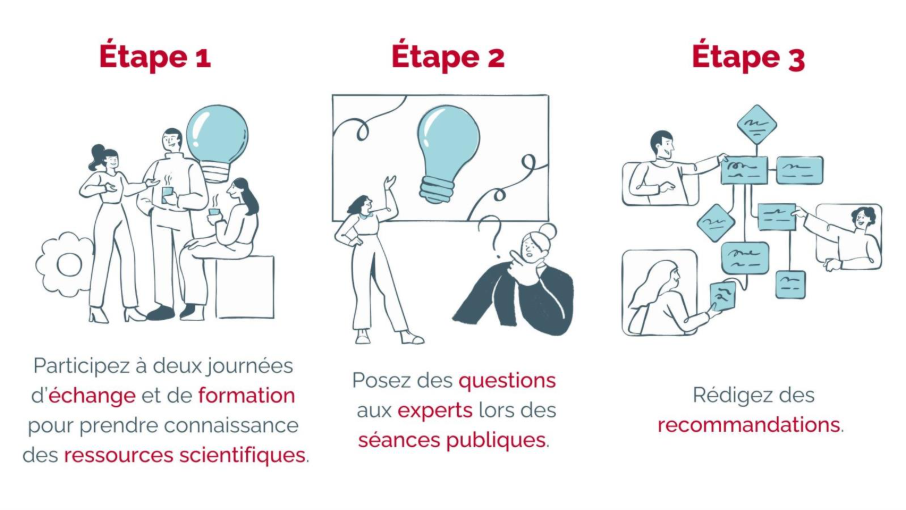
Stage 1 – Getting to grips with the scientific work
Jury members take part in two training days organised by the Cnesco ahead of the public sessions.
These days enable them to:
- familiarise themselves with their role as jury members;
- gain a thorough understanding of the conference theme;
- take stock of existing knowledge, practices and research on the subject under discussion;
- establish a collective working arrangement.
Stage 2 – Taking part in the public sessions
The public sessions alternate between expert presentations and exchanges with jury members, in order to feed collective reflection and prepare the drafting of recommendations. Questions are prepared in advance by jury members.
Stage 3 – Drafting the recommendations
Following the public sessions, the jury produces concrete, research-based recommendations intended for the educational community.
Who can become a jury member?
The call for applications is open to all members of the educational community: teachers and trainee teachers (from nursery to upper secondary school), parents, students (secondary or higher education), school principals and head teachers, teacher trainers at Inspé institutions, educational advisers, school inspectors, school psychologists, and representatives of associations.
Practical arrangements for jury participation
When a Cnesco consensus conference is organised, the call for applications opens in March of the conference year. The jury then meets for the first time in June, and a second time in September/October. The public sessions take place in November, immediately followed by the closed deliberation.
🗓️ The next Cnesco consensus conference on “Adolescents in Middle School: How Can We Better Support Them?” will be held on November 3 and 4, 2026. The call for applications to serve on the conference jury is now closed.
Applicants must ensure that they will be available, or that their employer or administration will be able to release them, on each of the announced dates. Cnesco provides official invitations and attendance certificates to jury members whose employer or administration requires proof of absence.
All costs related to jury activities (travel, accommodation and meals) are fully covered by the organisers.
Former jury members share their experience
“What an enriching experience to have met such a diverse range of people around a fundamental educational theme — assessment! Three words come to mind to sum up the experience: pleasure, honour, pride. The pleasure of having been selected as a jury member. The honour of having contributed to representing the educational community. And the pride of being able to say: “I was there!””
School Inspector
“From this consensus conference, what I take away above all is the wealth of documents made available to us by the participating researchers and the quality of their contributions during the two days of presentations. More than anything, it was a unique experience to exchange views with the other jury members, to think collectively, to compare our perspectives and experiences, while allowing ourselves to think outside the usual institutional constraints.”
Upper secondary school chemistry and physics teacher
“What a rich and unique experience to work on expert and scientific notes and discover how fascinating their writings can be. The scientific — or sometimes education-specific — jargon is not as impenetrable as one might think. Being part of the jury alongside enthusiastic people, generous with their knowledge and field experience. A wonderful cross-section of the educational community, working with cohesion and team spirit, in a joyful and supportive atmosphere.”
Parent of school children